Apparently ‘2026 Is The New 2016’

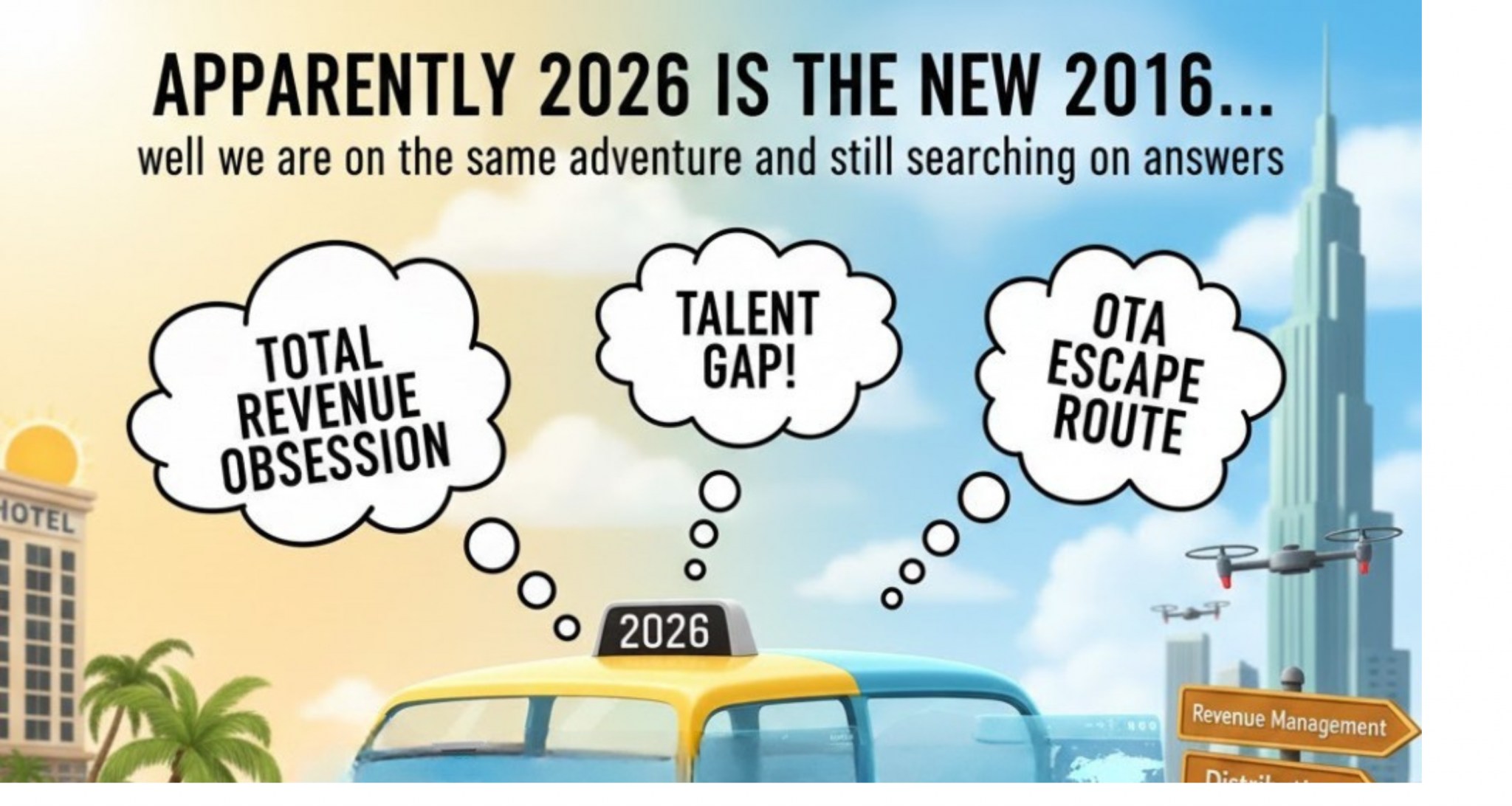
‘2026 Is The New 2016’.. This trend seems to be going hot still, so here is my taking it an applying it to Revenue Management for your weekend read.
If I compare 2016 and 2026, the revenue teams are in a place of “Deja vu” moments across most areas. Much like 10 years back, we are
· Still obsessed with “Total Revenue Management”
· We are still complaining about a lack of talent
· Still trying to figure out how to stop guests from booking via OTAs.
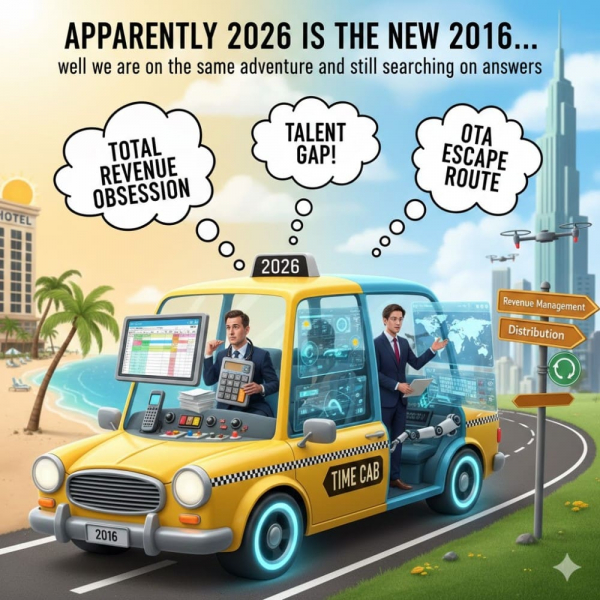
But while it looks like we have been stuck in a rut, the reality is there is so much that has changed as we moved from human labor to machine intelligence.
So here is my 5 mins read on how the landscape of Revenue Management (RM) and Distribution has evolved—and where it’s stuck in a time loop. Smile, if you related to it, because that’s what this post is expected to do.
1. Old Names, New Stakes – The Strategy:
In 2016, Total Revenue Management (TRM) was a cool buzzword. In 2026, it is a requirement.
- Then (2016): TRM was mostly about trying to get the F&B manager to talk to the Revenue Manager. Ancillary revenue meant selling that extra spa treatment or a wine bottle or a paid late checkout/ upgrade.
- Now (2026): We’ve moved from RevPAR and cool sounding TRevPAR to cooler sounding terms such as RevPAG (Revenue Per Available Guest) and RevPSM (Revenue Per Square Metre). Learning from Airlines, Hotels now use “Attribute-Based Selling,” where every micro-item from the panoramic little balconies to the extra view, to the ergonomic chair for remote work, and the quiet room that’s far from elevator are being dynamically priced.
- The Same Silos: But we are still fighting the “Silo” war. Better tech or not, getting the departments to communicate, share and work towards the same goal (profit vs revenue) remains the biggest internal hurdle.
2. From Excel Dashboards to “AI Co-Pilots” – The Technology:
If 2016 was the era of “Big Data,” 2026 is the era of “AI is the answer.”
- Then (2016): Revenue Managers spent 80% of their day in Excel, “cleaning” data, creating reporting charts and manually pushing rates to a Channel Manager. In most place, automation meant “rules-based” strategy (e.g., if occupancy > X%, raise rate by $Y).
- Now (2026): AI is the buzzword across all tech tools. It doesn’t just suggest a price; it executes strategy across 100s of channels in real-time. Systems now consider a lot of bigger data across “direct and indirect sources” be it local weather forecasts, flight delays, and even social media driven travel trends to predict demand spikes.
- Connections are still the Same:The new industry tech is continues to get fragmented. We have the latest AI tool that can optimize so many channels trying to talk to a 20 year old PMS. One day we will cross the hurdle of getting the tech stacks to talk to each other seamlessly.
3. The New Wealth : Information
If the statement “information is wealth” is true then in 2026, the guest is the wealthiest person in the room.
- Then (2016): Guests used TripAdvisor to check reviews and Google to search for answers. While transparency was high, the “buying journey” was still linear and manual (Search multiple sites -> Compare -> Book).
- Now (2026): The “Automated / Agentic Internet” means guests have Generative Search. Instead of browsing ten sites like in 2016, they ask an AI agent: “Find me a boutique hotel in XXX city, near XXX location for under $YYY with a gym and high-speed Wi-Fi, and review rating is above 4.5.” While Agentic tools are still struggling with the bookings process, that’s not too far away
- And more: And there’s even more complexity: Distribution today goes far beyond just direct channels and OTAs. The constant redistribution of rates means prices don’t stay confined to a single channel, moving real time and instantly appearing across the marketplaces. On top of that, the rise of social commerce has given Revenue leaders a new challenge: they must vigilantly monitor viral trends and buzzworthy moments about destinations, since a single post can trigger an immediate surge or drop in demand.
4. The Talent Gap: The More Things Change…
This must be the most striking and stagnant “2016 is the new 2026” parallel. We are still short on people and talent.
- The Brain Drain: Just as in 2016, the industry struggles to find and keep real analytical talent. The reasons remain the same as I realized from a recent roundtable – long hours, work life balance, lower salaries.
- The Skill Shift: In 2016, we needed “Data Crunchers and Analysts.” In 2026, we need “Strategists.” Since the AI can now handle the math and number crunching, the human must handle the “Why and How” – Take the data and interpret it considering expectations, brand positioning, and the “many vibes” that a machine can’t yet quantify today.
So where are we:2026 feels like 2016 because we are still chasing the same dream of “Total Profitability.”
The difference is that in 2016, we were trying to build the car while driving it; in 2026, we now have the self-driving car, but the passengers are still arguing over the destination.
Originally Posted in: