GM Perspectives – AI Focus Group, AI & Automation in Real World Applications, Competitive Pressures and Geopolitical Uncertainty
Insights from the HSMAI General Managers Roundtable, Bangkok — March 2026
HSMAI Asia Pacific | Bangkok, March 24, 2026
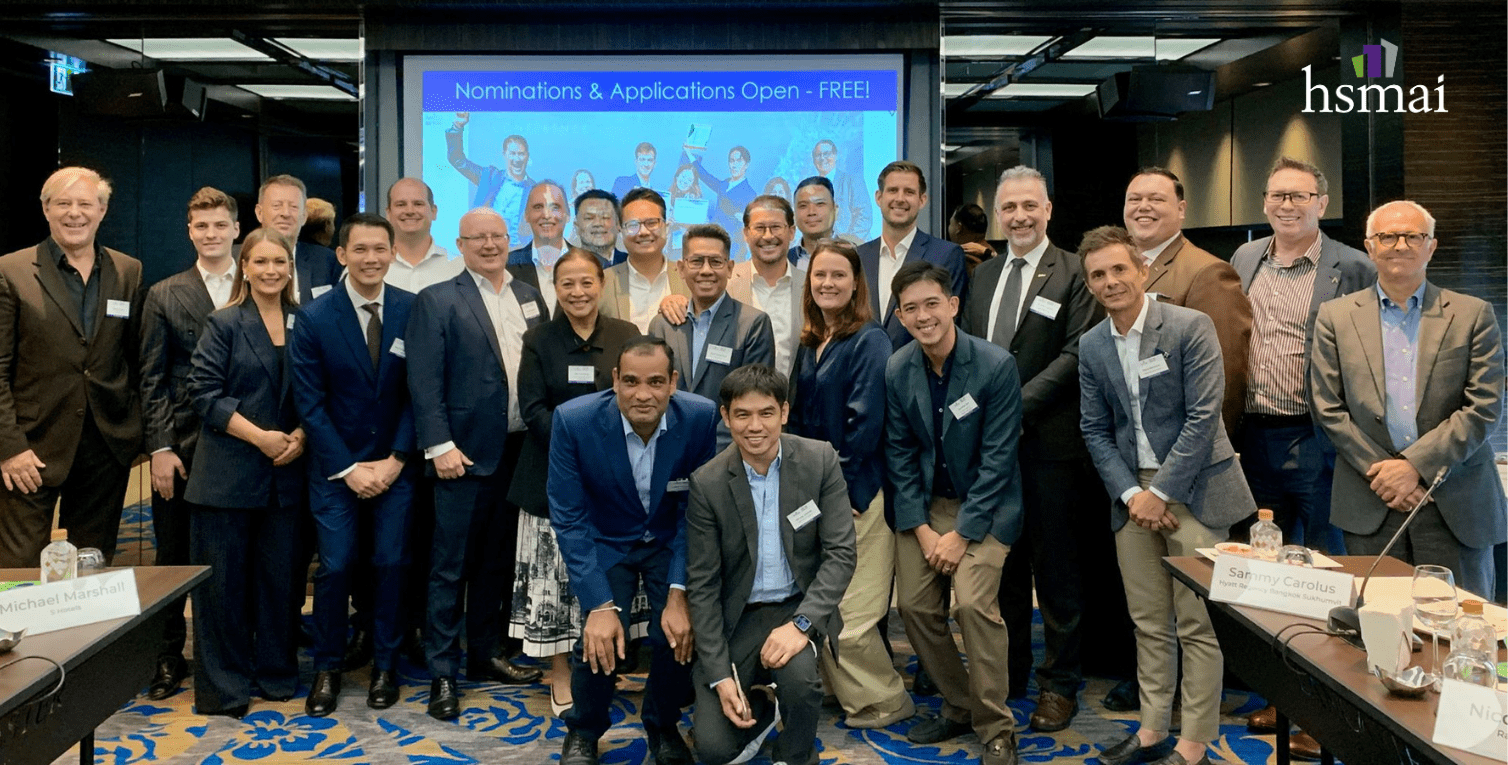
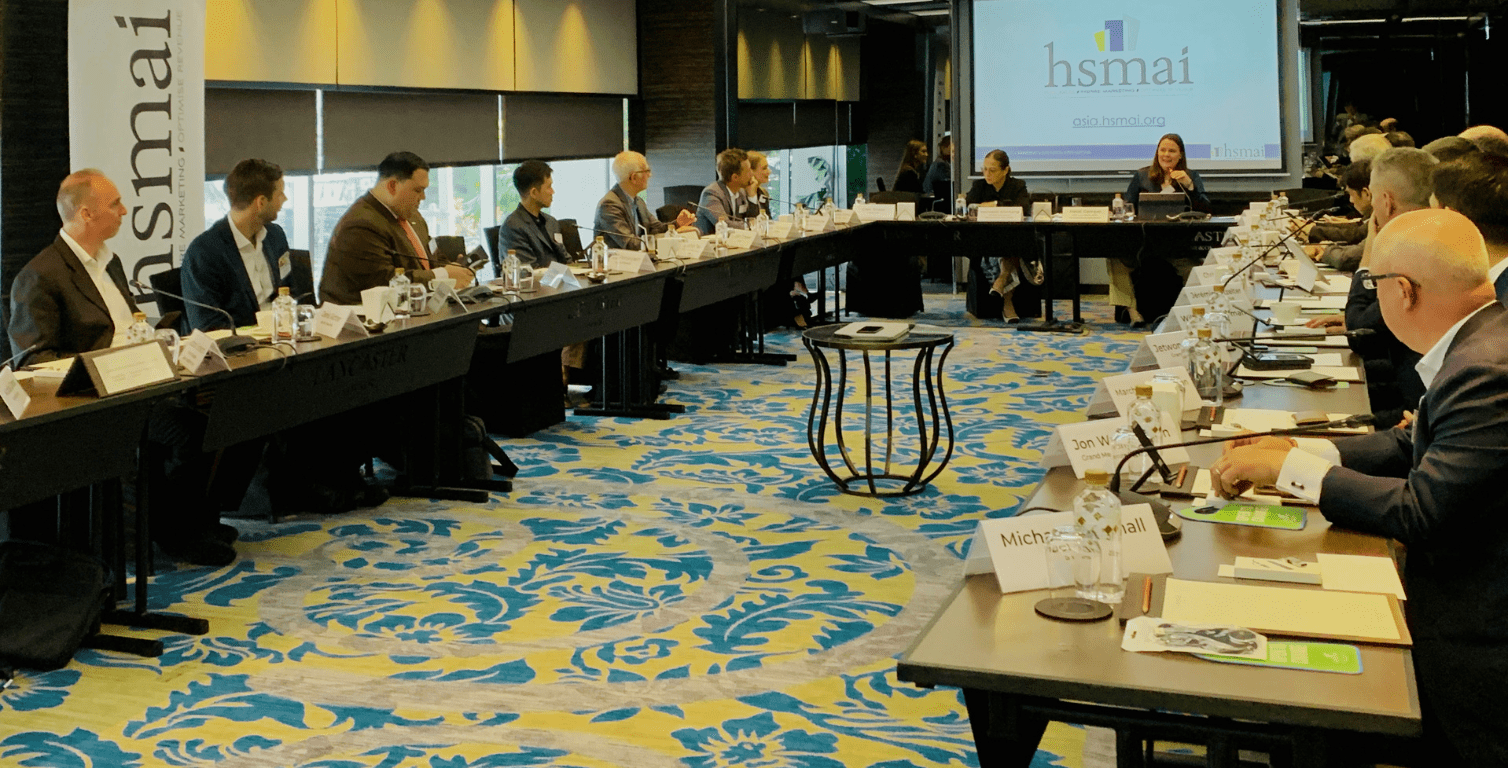
Hotel leaders from Bangkok and other destinations of Thailand gathered for the HSMAI Asia Pacific Thailand General Managers Roundtable in March 2026. The session was structured as an open, peer-to-peer exchange across three core topics: the role and definition of AI in hospitality, its practical application while preserving Thai warmth, and the competitive pressures facing Bangkok hotels — made more urgent by the ongoing conflict in Iran. What follows is a summary of the key insights from each topic.
Post-Discussion Summary: Intelligent Tools, Human Leadership
The discussion demonstrated that most sophisticated hospitality leaders are not asking whether to adopt AI — they are asking how to adopt it wisely. The answers emerging from the room are nuanced: automate the back-of-house so humans can thrive in the front; trust AI to surface data but not to replace judgment; design your tech stack around your guest experience vision, not your procurement policy; and never let a rule substitute for the right ‘human’ thing to do.
Against the backdrop of geopolitical disruption, the message was equally clear: this season will demand agility, creativity, and above all, leadership. Bangkok’s hotels have faced crises before. The tools available to navigate this one are better than ever — provided the humans using them bring the judgment, empathy, and hospitality instinct that no algorithm can replicate.
Prelude – Opening Discussion: What Is AI — and What Isn’t It?
The session opened with a deceptively simple question: What is AI? The responses revealed a room of thoughtful practitioners, each drawing from their own operational reality.
The room agreed on one foundational distinction: automation and AI are not the same thing. Automation can be achieved through basic coding and workflow tools without any AI involvement. True AI goes further — it processes data to support decision-making in ways that are understandable and contextually meaningful.
One participant viewed AI’s current value as fundamentally about automation — streamlining tasks so that revenue managers, department heads, and front-line staff can focus on higher-value work rather than the granular and repetitive. He also distinguished between where AI is today (practical, task-oriented) and where it is heading — toward agentic AI and eventually general intelligence at human levels.
Participants generally agreed that AI’s current value is primarily a tool that removes the burden of routine tasks — reporting, data analysis, content generation — freeing staff to focus on other more important tasks or guest interaction.
There was also a shared hope that AI, done right, would restore the time and headspace for genuine hospitality: more empathy, less administration. This vision of AI as a tool that restores the soul of hospitality, rather than replacing it, became a recurring theme across all three discussion topics.
One important cautionary note emerged clearly: AI is only as good as the data and prompts it receives. “Garbage in, garbage out” was a phrase echoed more than once. Several participants also cautioned against uncritical trust — one participant estimated that roughly one in five AI-generated responses contains errors, making verification and human judgment indispensable.
1. The GM Perspectives Focus Group: AI – An Asset or Automated Interruption
The first structured segment of the afternoon was a focus group – presenting real-world hotel scenarios where AI can assist the hotelier to make decisions. The scenarios were a mix of hotel operations, revenue management, and leadership decision making, and asking participants to rate their applicability using live polling (Slido) then briefly open discussion within the group. The scenarios provoked rich debate.
Scenario: The Holiday Overlap Dilemma
This scenario explored a situation where two public holidays — Easter and a fixed-date national holiday in late April — were in close proximity, creating a complex and unpredictable demand pattern. Historically, hotels had missed the impact because the data was too scattered and multi-layered to interpret quickly. Participants agreed that this was precisely where AI could add value: not in making the decision for the revenue manager, but in crunching vast data sets — forward pace, school holiday calendars, room category performance — and presenting it in an interpretable, humanized summary. The consensus was that AI should help surface the insight, while the human makes the call.
Scenario: Group Displacement vs. Leisure High-Spenders
This scenario involved a group requesting 50 rooms at a discounted rate with zero food and beverage spend, being weighed against projected high-value leisure guests likely to spend significantly at the spa and restaurants. The AI tool recommended rejecting the group or counter-offering with an F&B minimum.
Participants debated the scenario’s real-world limitations — noting that a complete picture would require factoring in existing on-the-books business, banquet revenue, category inventory, and more. However, the group converged on a nuanced consensus: while experienced commercial leaders might not need AI to prompt this conversation, junior sales staff often lack the confidence to challenge group business or bring it to a commercial discussion. In that context, the AI tool serves a valuable purpose — giving less experienced team members a framework, measurement method, and a conversation starter with context to take it to their leader with context.
Scenario: Tech Stack Integration — “Best Is the Cheapest”
One of the more thought-provoking scenarios addressed the trap of procuring hotel technology by cheapest price rather than by compatibility and strategic fit. Many participants acknowledged this was a real challenge — especially in properties where purchasing policy mandates three quotes and defaults to the lowest bid. The discussion surfaced a key principle: technology strategy should follow business process design, not precede it. One participant stated that before selecting any system — PMS, channel manager, RMS — a hotel must first define the guest experience it wants to deliver and the operational model it wants to achieve the objective. The tech stack should then be built to support that vision.
Scenario: Digital Memory Check-In
This scenario imagined a high-net-worth guest from Dubai arriving after a long flight, with the hotel’s AI system having pre-researched the guest’s preferences and alerting the team to prepare accordingly. While the concept was broadly welcomed as a vision of proactive hospitality, participants raised a key challenge: data integration. For AI to enable this, it must be able to draw on consistent, accurate guest history — which requires connected systems, good data hygiene, and cross-property sharing where applicable. Many properties acknowledged they are not yet there. In addition, it was also noted that privacy must be factored in when using guest history and preferences, while it’s a nice theory to anticipate a guests needs based on his profile history it would have to be done in a way that didn’t infringe upon a guests privacy.
2. AI & Automation in Practice: Keeping the Human at the Heart of Thai Hospitality
The second major discussion topic turned from the theoretical to the operational: how is AI being used today in Bangkok hotels, and how do we preserve the warmth and emotional resonance of Thai hospitality in an increasingly automated world?
Current Applications Across the Room
Participants shared a wide range of current implementations:
- Marketing teams are using ChatGPT for content creation, social media copy, and AI-generated promotional imagery, saving significant time on campaign production.
- Review aggregation platforms are using AI to collate and analyse guest feedback from multiple sources, while human team members still craft the personal responses.
- One major international brand has integrated ChatGPT directly into its loyalty app, enabling guests to search for hotels using natural language — though only within the brand’s own portfolio.
- Finance teams are using enterprise-licensed AI (such as Microsoft Copilot and restricted ChatGPT instances) to generate reports in a fraction of the time — one participant noted a 50% productivity improvement in financial reporting.
- In housekeeping, one Singapore property shared a compelling case: AI tools directing housekeeping staff to the next room based on occupancy patterns and traffic monitoring in public areas resulted in a 20–40% reduction in cleaning time, without any drop in guest satisfaction scores.
- One participant described AI as “a tool to balance between human and technology” — handling the informational and reporting tasks that don’t require guest interaction, freeing staff to deliver a more personal experience.
- Another younger hotelier, framed it as “enhanced human intelligence” — a resource that enables better decision-making by allowing anyone to quickly learn and process information on unfamiliar topics.
The Human-Technology Balance
The most animated part of this section was the debate over where human interaction ends and automation begins — and whether it differs by hotel category, nationality, and guest generation.
There was broad consensus that luxury and upper-upscale hotels should guard the primacy of human service. As one participant put it, “You pay for top five-star and get checked in by a bot — that doesn’t make sense.” The Ritz-Carlton philosophy of the three steps of service — warm welcome, anticipating needs, fond farewell — was cited as an enduring standard that AI should support, not supplant.
However, for mid-scale and lifestyle hotels, the picture is evolving rapidly. Owners in Asia are increasingly aware of lean staffing models operating in Europe and questioning why similar efficiencies cannot apply in Asia. Several participants acknowledged that the economics of mid-scale hospitality are pushing toward greater automation, a shift likely to accelerate in uncertain economic conditions.
Nationality and generational preferences added further nuance. Chinese guests, particularly those travelling domestically or within Asia, were described as comfortable — even preferring — self-service kiosk check-in for its speed. European and Australian guests, by contrast, were more likely to seek personal interaction and the warmth that defines Thai hospitality. “They come from overseas and they want to experience this — there’s no way to automate that for this kind of guest,” noted one participant.
One chain’s CEO-level directive was shared as a useful north star: “AI is only the enabler, not the replacement for human connection. Emotional connection is still the most important factor in hospitality.” The goal, as articulated across multiple contributors, is to use AI to eliminate back-of-house friction — reporting, routing, data analysis — so that front-line staff have more time and energy to deliver genuine human moments.
3. Bangkok’s Competitive Landscape: Challenges and Opportunities
The third topic — Bangkok’s competitiveness — was perhaps the most raw. Facilitators had originally designed it without anticipating the conflict in Iran, but the discussion could not be separated from it.
Structural Challenges Pre-Dating the Conflict
Even before the current geopolitical crisis, Bangkok’s hotel market was facing significant structural pressure. Tourist arrivals have not returned to 2019’s pre-pandemic peak of 40 million, yet the number of hotel rooms has continued to grow — with approximately 5,000 new rooms added to Bangkok in the past year alone. The supply-demand imbalance is squeezing RevPAR and compressing margins across all segments.
Participants also noted a broader deterioration in service culture post-COVID, described as a shift from a “culture of yes” to a “culture of rules.” Staff trained during the pandemic to enforce restrictions appear, in some properties, to have retained that rule-following mindset even as the rules themselves became irrelevant. Stories were shared of guests encountering rigid inflexibility in situations that called for simple human judgment. “It’s not about following the rule — it’s about what’s the right thing to do,” observed one GM.
There was also frank discussion about the challenge of sustaining a motivated workforce in a maturing economy. As Thailand grows wealthier, hospitality careers face stiffer competition from other industries, and the sense of prestige associated with working in a luxury hotel diminishes — a trajectory already observed in China, Singapore, and other more mature markets.
The Iran Conflict: Immediate and Cascading Impact
The war in Iran cast a shadow over the final part of the afternoon. Several participants described impacts already being felt in real time:
- Airlines routed through Middle Eastern hubs have rerouted or reduced services, disrupting airline crew accommodation contracts. One participant described patterns of 68–70 crew rooms per night dropping to 23 overnight, with no alternative business to replace them.
- Energy costs are surging. One property burning heavy fuel oil for water heating reported the price doubling from 12–16 baht per litre to 28 baht per litre — a cost that cannot be passed on to guests but cannot be turned off.
- Forward bookings from Europe are stalling, with travelers uncertain whether flights will continue to operate, particularly those connecting through Dubai and Doha. Prices on direct long-haul routes have doubled, suppressing demand.
- Domestic Thai travel — flagged as a potential buffer — faces its own headwinds, with household debt levels high and government-funded staycation programmes still owed payments from previous Covid-era schemes.
- Revenue system recalibration: One participant noted that their revenue management system (IDeaS) was already detecting anomalies in booking patterns — repositioning pricing without knowing there was a conflict at play. The system knows something is off; the human team provides the context. This interplay between AI pattern recognition and human commercial judgment was held up as the appropriate model for the period ahead.
Several participants drew direct parallels to COVID-19, with some going further: “I think it has potential to be way bigger than Covid,” said one GM. The combination of energy price volatility, currency instability, disrupted air routes, and geopolitical anxiety creates a multi-layered challenge that no single hotel can solve independently.
What Hotels Can Control
Rather than dwell on what cannot be controlled, the discussion turned to actionable strategy. Several themes emerged:
- Segmentation pivot: Singapore’s Pan Pacific was cited as a model, having quickly pivoted to target the Australian market — a segment with the budget for premium travel, direct flight access, and now a preference for shorter-haul destinations as Europe becomes logistically difficult. Bangkok properties with the right product and price point could make a similar play.
- Value creation through guest experience: Rather than competing on price, participants were encouraged to think about which moments in the guest journey generate genuine emotional impact, and to concentrate human and technological resources there. Identify three key moments — arrival, recovery, or a signature brand experience — and use the next six to eight weeks to measure whether intentional improvement in those moments shows up in guest feedback and productivity scores.
- Destination quality: Broader concerns were raised about Thailand’s destination experience — particularly overcrowded sites like Maya Beach, where visitor management has stripped the experience of any joy. Participants argued that Thailand’s path to competitiveness lies not in growing visitor numbers further, but in moving upmarket and curating quality.
4. Closing Reflections: Leadership in an Uncertain Season
The roundtable concluded on a constructive note. The facilitator acknowledged that what had begun as a discussion about AI had revealed something deeper: the extraordinary demands being placed on hotel leadership in a period of compounding uncertainty.
“What is coming your way is a tough season,” she told the room. The value of peer communities — places where GMs can speak honestly about what they are facing without competitive guarding — was underscored throughout the afternoon.
On a forward-looking note, HSMAI also announced its Rising Leaders and Trailblazer Awards for 2026, encouraging GMs to nominate outstanding commercial team members. The awards — judged by industry peers at the Commercial Strategy Conference in Singapore — represent one of the association’s commitments to recognising and retaining talent in a sector where career mobility is high and recognition matters more than ever. HSMAI also offered two complimentary passes to each hotel property in attendance to its commercial hotelier community event PowerUp Bangkok on 1st April 4:30pm to 7:30pm at Oriental Residences Bangkok.