Making Sense of AI in Demand Intelligence and Pricing
Hotel technologies are constantly evolving. Understanding which innovations deliver the greatest commercial impact is becoming increasingly difficult, particularly as industry attention intensifies around AI. With a growing mix of tools and capabilities entering the market, it can be challenging for hotel teams to separate practical value from broader hype.
To navigate this effectively, hotels need a clearer understanding of the different types of AI, where they can be applied and how emerging tools are reshaping not just operations, but demand generation itself.
How is AI actually being used in hospitality today?
While AI in hospitality is often discussed as a set of emerging categories, not all AI is designed to make — or should be trusted with – high‑stakes commercial decisions.
The most easily recognized form of AI in hospitality today is generative AI, which utilises sophisticated large language models (LLMs) to help hotel teams quickly write, summarise and analyse text, images and data. This application of AI can help staff save time and communicate more effectively. In a hotel environment, this can support content-based activities like drafting marketing copy or personalising pre-arrival messages to welcome guests. It can also turn large datasets into simple summaries for managers, assist with multilingual guest communication and help frontline teams access information instantly without searching through manuals or document libraries. When used well and fed by trustworthy inputs, it improves productivity across marketing, operations and reporting by streamlining repetitive work, particularly in content- and communication-driven tasks.
Agentic AI is an emerging category of artificial intelligence that can autonomously act on information rather than simply present it. It can take inputs, interpret what they mean for the business and complete tasks without waiting for a human prompt. At their most sophisticated, these AI agents can plan, decide, carry out and evaluate entire sequences with minimal human oversight, making them more like digital teammates that automate workflows and free up key hotel personnel. In a hospitality setting, this could support operations by triggering housekeeping schedules based on actual occupancy rather than static plans or adjusting pricing or rate restriction guidelines when forecast demand shifts.
The limits of generative AI and agentic AI
The usefulness of these approaches depends heavily on the type of decisions they are applied to — and the foundations they are built on.
While generative AI can help speed up content generation, it has limitations and should only be used in specific areas of hotel operations. For instance, it is not built to make precise pricing or forecasting recommendations, nor does it contain the specialised logic needed for accurate strategic analysis and adjustments. It predicts likely words or images rather than calculating the best commercial decision using demand science, forecasting models and robust optimisation logic.
Few hotels today are also tapping into the full potential of agentic AI, as it requires significant prerequisites. Clean, centralised data, consistent business rules and clear governance frameworks are essential to determine what can be automated and what must remain under human control. Agentic AI should only be introduced once these data foundations and governance frameworks are firmly in place.
The right AI foundation for revenue optimisation
This is why, when it comes to revenue optimisation, not all AI foundations are equal. For agentic and generative AI capabilities to shine when applied to revenue and commercial strategies, they first need a layer that’s fit for the purpose. Mathematical AI is the science behind modern revenue management. These are proven, tailored algorithms that forecast demand, determine availability restrictions and recommend the right price at the right time. Over the years, these algorithms have become increasingly refined, delivering precise recommendations for every segment, room type and length of stay to support holistic revenue optimisation. This form of AI has quietly delivered reliable revenue optimisation for years and, for many hotels, is already the cornerstone of their commercial AI strategy.
In the context of commercial strategy, revenue management is where mathematical AI currently proves its value most consistently. While many emerging AI tools promise to streamline operations or personalise guest interactions, mathematical AI has long delivered measurable financial impact, including RevPAR growth. It transforms raw demand signals into accurate forecasts and powers intelligent pricing. Increasingly, these systems also enable real-time decision making in response to sharp demand shifts, helping hotels adapt to fast-changing market conditions. With scenario simulation capabilities, teams can test strategies before implementation, avoiding costly missteps and better aligning decisions with business goals.
For many hotel teams, there’s a delta between what can be done with AI and what can be entrusted to AI. Without a strong mathematical AI foundation that’s equipped for intelligently handling the complexities of hospitality revenue management, this trust gap will persist for strategic and tactical commercial execution.
The risk of a system with expanded autonomy isn’t just the chance it gets something wrong—it’s the risk of it carrying on at scale without it knowing the foundational logic guiding decisions is faulty.
The next frontier in demand generation
While revenue management technology has transformed how hotels price and forecast demand, these predictive insights derived from mathematical AI rarely reach marketing teams in a timely way. As a result, marketing decisions are often made without understanding a demand period’s level of influenceability. For instance, a promotional campaign might be launched during a low-demand period where no amount of advertising can influence travellers to book. Without clarity on the dynamics of specific booking periods, hotels risk wasting valuable marketing resources and missing opportunities to stimulate the right kind of demand.
This is where the next generation of AI-enabled, data-driven tools is changing the conversation. Today, the latest innovations in revenue management go beyond simply predicting demand, they now have the ability to provide intelligence on how sensitive that demand is to marketing activity. This means a hotel can not only see when occupancy will be low, but also why, and whether targeted campaigns are likely to shift guest behaviour
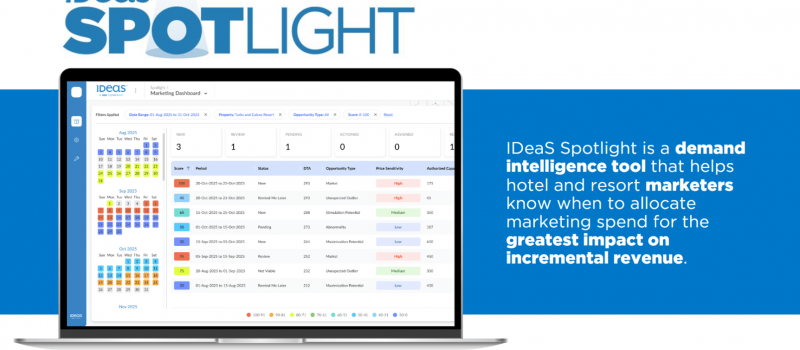
New solutions such as IDeaS Spotlight are designed to bring this level of intelligence into play. Built on advanced forecasting and price sensitivity analysis rooted in revenue science, Spotlight connects revenue and marketing functions to help teams understand when and where marketing spend can generate measurable results. Instead of running campaigns based on assumptions, hotels can now prioritise those that will genuinely impact revenue.
A more unified approach to hotel operations
Hotel technology is moving towards a more integrated model, where the boundaries between forecasting, pricing, marketing and operations are becoming less distinct. Those that prioritise building a foundation of tech integration, data consistency and cross-departmental collaboration will be in a stronger position to make informed decisions and capitalise on revenue opportunities.
For more information on how AI and advanced demand generation tools can improve the commercial operations of your hotel, please visit: www.ideas.com