From Fear to Confidence:
How Hotel Commercial Leaders Can Adopt AI and New Technology with Clarity


For hotel commercial leaders today, the pace of technological change—especially AI—is both exciting and unsettling. New tools promise better personalization, smarter pricing, and improved efficiency. Yet many teams hesitate, unsure which technologies to trust and how to adopt them without introducing unnecessary risk or disruption.
We are operating in a period where the status quo is constantly shifting. Generative AI, predictive analytics, automation, and intelligent systems are reshaping hospitality faster than most organizations can fully absorb. In this environment, uncertainty is natural—but uncertainty should lead to better questions, not hesitation.
When I started my sales career, I went through all the standard sales and marketing training but couldn’t find a clear answer to what comes next. So I studied the most successful “sales institutions”—pyramid schemes, politicians, and clergymen.
It quickly became clear that fear is the most powerful ingredient to leverage, relief from fear the best product to sell, and the bliss (or ignorance?) of “no more fear” the ultimate after-sales experience.
We are now living in constant distress as the status quo ceases to exist. The relentless pace of AI innovation—generative tools, predictive analytics, personalized automation, and agentic systems—is reshaping hospitality faster than anyone can fully absorb. No one is immune to this acceleration, and in a world where predictions feel outdated almost immediately, insecurity is the default state.
With a sense of foreboding as the background music, we should be able to sell anything, to anyone, anytime.
The best product to sell, given this reality, is technology—especially AI-driven travel tech. Throughout history, technology has propelled us forward, especially in travel, horses, compass, wheels; cars, ships, planes, and spaceships, all of them not completely safe when first adopted. Yet we have excelled at using it to measure, communicate, access information, navigate, and gain reassurance. The same applies to pre-, during-, and post-trip tools like social media, and now AI personalization tools—they create and quench anxiety simultaneously. Perfecto!
In my search across startups and incumbents for the best-fitting travel technologies, one question always tops my mind: Does this solution cause more anxiety or solve it?
Resources such as Capterra, Software Advice, HotelTechReport, and ExploreTech can provide valuable guidance when evaluating potential solutions. Platforms like ExploreTech allow hoteliers to compare products across categories, integrations, features, and verified user feedback, helping narrow down suitable options more efficiently.
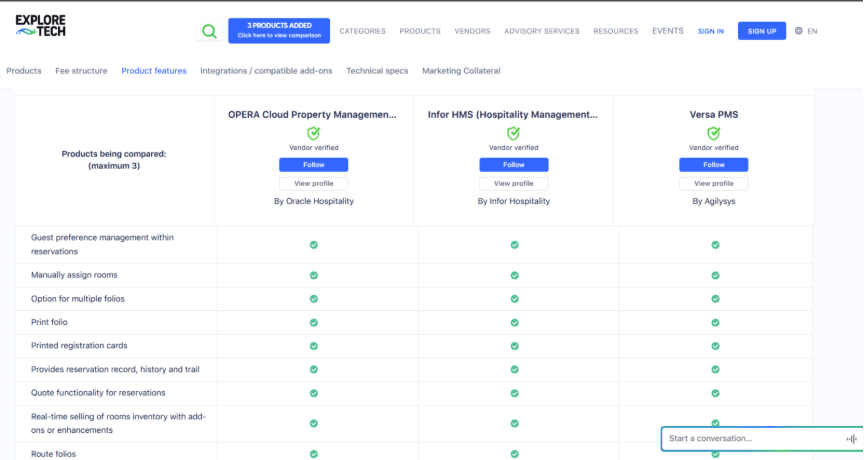
However, comparison platforms are only the starting point. Each hotel must develop its own structured framework to evaluate technology based on its specific commercial goals, operational realities, and long-term strategy.
A Practical 7-Step Framework for Evaluating New Technology
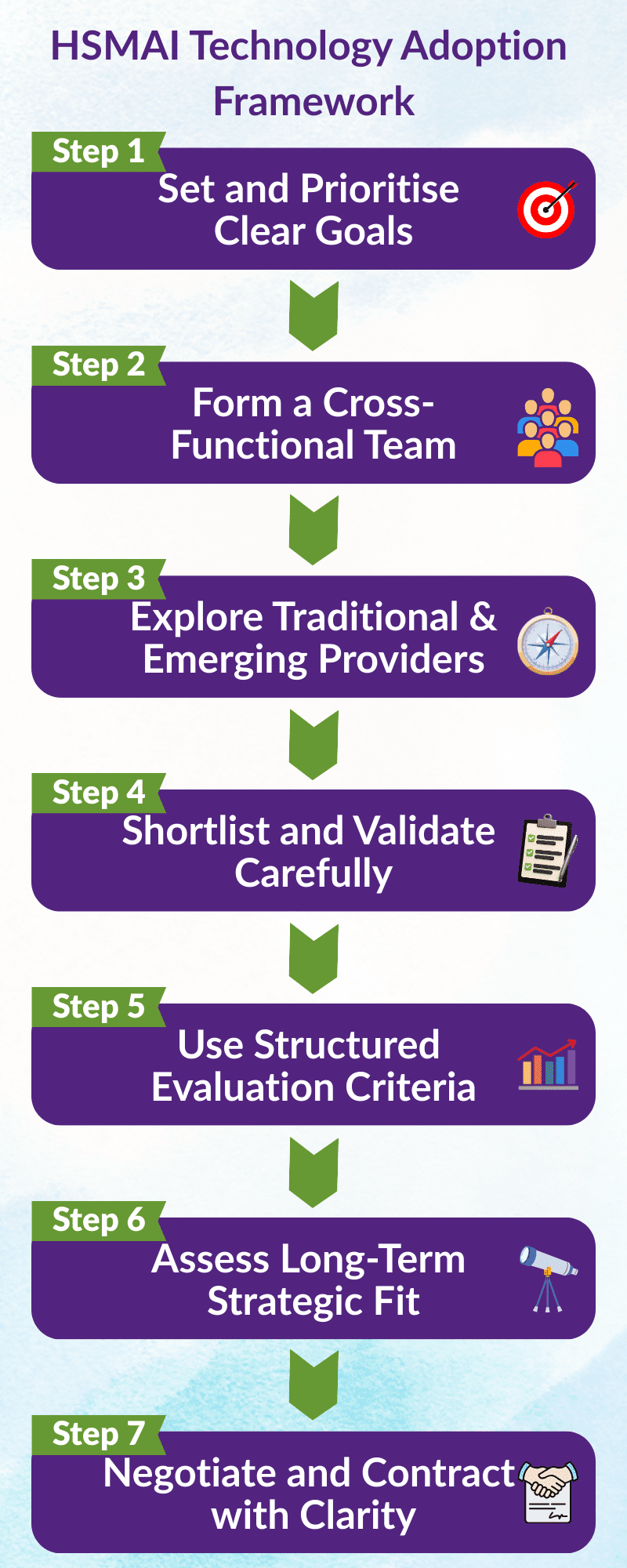
Step 1. Set and Prioritise Clear Goals
Technology should always serve a defined purpose. Identify the specific operational or commercial challenges you are trying to solve. Focus on defining clear, solvable goals for the technology solutions that address meaningful business needs and align with your long-term strategy. This will be a fairly painful prioritization and elimination process. The driver to add or replace technology is rarely to solve a single problem – and it might add other challenges like tech integration and operational complexity.
Step 2. Form a Cross-Functional Evaluation Team
Never try to conduct tech adoption or upgrade evaluations alone. Technology decisions should involve commercial, operational, customer-service and tech users, technology, and financial stakeholders. Cross-functional input reduces blind spots and improves decision quality.
Step 3. Explore Beyond Traditional Providers
Look beyond traditional suppliers – consider startups and adaptations from other sectors, spend around 30% of your time on exploring unusual options. While established providers offer stability and a lot of functionality, startups and adjacent industries often introduce innovative solutions that address longstanding challenges or address the specific goals you identified in Step 1 & 2.
Step 4. Shortlist and Validate Carefully
Create a shortlist of finalists for deeper presentations, discussions, and negotiations. Always include one or two wild cards—eliminating options too early stifles the open mindset essential for technology adoption.
Seek feedback from current or past users, particularly hotels with similar profiles. Real-world experience often reveals strengths and limitations not visible in demonstrations.
Step 5. Use Structured, Weighted Evaluation Criteria
Avoid simple additive scoring by a few people. Use cross-scoring, weighted systems aligned with company culture, and consider bringing in a third-party expert for relevant experience and independent scoring—especially for new or specialized AI tech.
Evaluate solutions based on commercial impact, integration capability, ease of use, scalability, and vendor reliability.
Step 6. Assess Long-Term Strategic Fit
Create a list of important but often-overlooked factors (e.g., provider willingness, ethics, sustainability, intrinsic long-term value) and ensure they are graded.
Consider the vendor’s product development roadmap, data governance practices, and alignment with your future strategy. Technology adoption is a long-term commitment.
Step 7. Negotiate with Clarity and Structure
Ensure all commitments discussed during evaluation are documented clearly. Maintain transparency and objective decision-making.
Contract drafting isn’t just for lawyers—a designated lead should create a clear term sheet capturing all discussed promises. Up to this point, keep two providers in play for leverage. The system should minimize human biases like chasing the cheapest or most famous option, reducing blame if things go wrong. Presentations, discussions, and negotiations should consume the most time and yield the richest data.
Questions to ask |
The reason you ask this question |
|---|---|
|
1. How does this technology improve the experience for both staff and guests?
|
We are a people industry. All good technology must position both staff and guests in a clear advantage after implementation. Avoid providers who can’t articulate this vision. |
|
2. How is data collected, governed, and used?
|
Beyond cybersecurity, how is data used, governed, and treated? If a company only talks about the vague “value of big data” without specifics, red flags should be flashing. |
| 3. Can we adopt this technology incrementally? | The smartest approach is incremental adoption—start with a phase and expand if successful. Both sides often bite off more than they can chew. |
| 4. How streamlined is the flow from data collection to insights? | Hotels rely heavily on offline experiences to deliver value, so the best tech minimizes unnecessary layers between data collection and delivery. |
| 5. Are there flexible commercial models available? Leasing or Profit-sharing? | This is an acid test of the provider’s confidence in product quality and ongoing support |
| 6. What is included in the future product roadmap? | You invest in technology for the future, not just today. This may be the most critical question. |
| 7. What are the true costs of implementation and exit? | Ask about both initial and exit costs and timeframe—providers rarely volunteer this proactively. |
| 8. How customizable is the solution? | This gauges provider flexibility and gives you the best shot at something truly unique for your property. If you can’t afford to customize, this is probably doesn’t matter. |
| 9. What is the realistic implementation timeline? | While variables exist, a capable provider should have a realistic timeframe. Project management skill is as vital as the product. |
| 1o. Can we meet the implementation team? | You learn volumes from the actual team. The worst scenario is dazzling sales reps handing off to an unprepared implementation crew. |

From Fear to Confidence
AI and emerging technologies are already shaping guest expectations. Hotels that adopt technology thoughtfully will be better positioned to improve efficiency, enhance guest experience, and drive commercial performance.
There is no doubt that without adopting emerging technologies—especially AI—we won’t stand a chance of meeting modern customer expectations. Guests now arrive with firsthand experience of AI innovation in work, entertainment, and daily life. Change is no longer optional.
The goal is not to adopt technology faster—but to adopt it smarter. When approached with clarity and discipline, technology becomes not a source of uncertainty—but a powerful driver of growth, confidence, and competitive advantage.