Improving Room Sales with Attribute-Based Pricing (ABP)

Introduction
Traditional hotel pricing relies on fixed “room types” and rate plans. While easy to manage, this approach hides the value of individual features and restricts flexibility. Modern travelers want to pay for what matters to them.
A multi-phase study, Attribute-Based Pricing in Hotels: Analyzing Industry, Customer, and Behavioral Insights by Denizci Guillet, Zhang, Madanoglu, and Gao (2026), tested ABP with over 700 participants. The results were clear: ABP with transparent price tags increases fairness perceptions, reduces price complexity, and raises booking intent compared to traditional bundles.
1. Guests value specific attributes — not room types
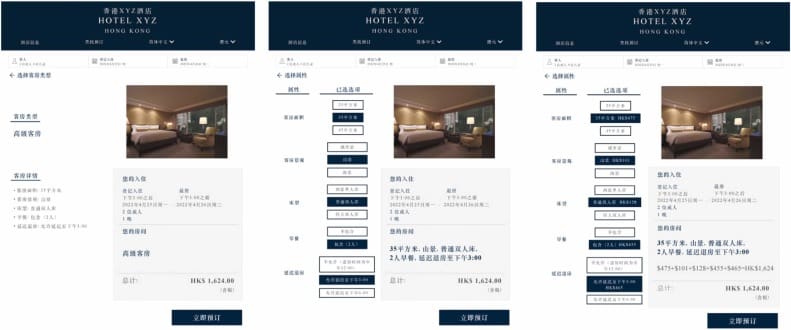
The research shows that customers do not inherently value room type names like “Deluxe” or “Premium.” Instead, they value the attributes contained inside them. The top 5 hotel attributes that drive buying decisions and revenue are:
- Room size
- Room view
- Breakfast inclusion
- Bed type
- Late check-out
Key takeaway: ABP aligns hotel retailing with how guests actually make decisions — based on features and value, not rate codes or room labels.
2. Customers will pay more for what they value
The study measured Guest Willingness to Pay (WTP) through conjoint pricing analysis. Results show customers attach real monetary value to specific room attributes:
| Attribute | WTP Premium |
| Sea view | USD $82 (CNY 580) |
| Breakfast for 2 | USD $64 (CNY 455) |
| Late checkout (to 3pm–6pm) | USD $65–69 (CNY 465–492) |
| Larger room (35–45 sqm) | USD $67–69 (CNY 475–491) |
| King bed over twin beds | USD $55 (CNY 389) |
Key takeaway: ABP unlocks incremental revenue hidden inside room types today. It monetizes value, not discounts.
3. Transparency is non-negotiable for ABP to succeed
Three pricing formats were tested:
- Traditional Room Pricing (TRP)
- ABP without price tags
- ABP with price tags
Only ABP with visible attribute pricing:
✅ Improved booking intent
✅ Increased perceived value
✅ Built trust
Key takeaway: If ABP is not transparent, it backfires. Guests won’t pay more unless they understand what they’re paying for and why.
4. ABP reduces decision friction when implemented correctly
Clear attribute pricing helps guests make decisions faster by comparing value, not just price. ABP with price tags reduced confusion compared to TRP because it simplifies comparisons.
However:
- ABP without price tags increases complexity
- Guests feel “manipulated by hidden fees”
Key takeaway: ABP must be simple, structured, and easy to evaluate — otherwise conversion will drop.
5. Perceived fairness drives conversion
Guests book more often when pricing is seen as fair.
ABP increases perceived fairness by clearly showing “you only pay for what you value.”
Fairness improves:
- Trust
- Booking intent
- Upsell acceptance
Key takeaway: ABP is a psychological win as much as a revenue win.
6. ABP impacts distribution strategy — not just revenue
ABP isn’t a revenue-only project. It fundamentally changes how hotels distribute price and product:
- Rate parity evolves → from room parity to attribute parity
- Channel plans change → not all attributes should be sold on OTAs
- Content complexity increases → systems must map attributes across Brand.com, CRS, PMS, OTAs, GDS
- Governance required → Revenue + Distribution must co-lead this
Key takeaway: Distribution strategy will make or break ABP success.
7. Industry proof points — ABP is already happening
Real companies are already moving:
- Expedia (2023): attribute-based shopping increased premium room bookings by 4.1%
- IHG (2020–): ABP logic built into new Guest Reservation System (GRS)
- Marriott: live ABP-style attribute selection in selected markets
- GauVendi: full ABP retail model already live in Europe
Key takeaway: ABP is now real, not theoretical. Early adopters are gaining retail advantage.
Conclusion
Attribute-Based Pricing is not just a pricing innovation.
It’s a new retail model for hotels that:
- Personalizes choice
- Unlocks incremental revenue
- Strengthens direct channels
- Challenges OTA advantage
- Demands commercial leadership from Distribution